Evaluating Procreate Brush Stamps 90s Nostalgia for Digital Art Projects
Digital illustration has evolved to encompass a wide range of aesthetic styles, from hyper-realism to abstract minimalism. Among the most enduring and emotionally resonant trends is the revival of 1990s visual culture. For artists using the iPad and Procreate application, Procreate Brush Stamps 90s Nostalgia offers a specialized toolkit to replicate the textures, objects, and atmosphere of that decade. These digital assets are not merely decorative; they serve as functional elements that can define the mood and narrative of an artwork. Understanding the utility, limitations, and appropriate applications of these brush stamps is essential for artists deciding whether to integrate them into their workflow.
Defining the 90s Nostalgia Aesthetic in Digital Tools
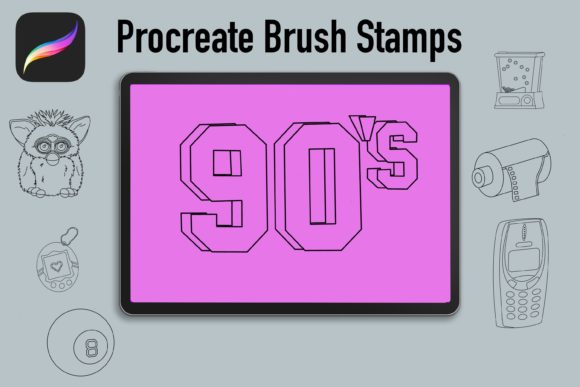
When discussing Procreate Brush Stamps 90s Nostalgia, the focus is on pre-made digital shapes that mimic iconic items from the era between 1990 and 1999. Unlike standard brushes that create strokes based on pressure and velocity, stamp brushes deposit a specific image onto the canvas with a single tap. Common subjects include the floppy disk, representing early data storage; the compact disc (CD) with its iridescent reflection; the cassette tape, synonymous with mixtapes and analog audio; and the bulky old PC monitors with their distinct CRT curvature.
These stamps often incorporate the grainy texture, dithering patterns, and vibrant yet slightly muted color palettes characteristic of 90s graphic design and early computer interfaces. The goal is to bypass the time-consuming process of manually drawing these complex objects from scratch, allowing the artist to focus on composition and storytelling while maintaining historical accuracy in the details.
Reasons for Adoption and Creative Benefits
Artists may consider adopting these tools for several practical and creative reasons. The primary benefit is efficiency. Rendering a realistic cassette tape with all its label details, screws, and transparent plastic casing can take hours when drawn manually. A high-quality stamp reduces this to seconds, enabling rapid prototyping of ideas or faster completion of client work. This efficiency is particularly valuable for illustrators working on editorial pieces, social media content, or merchandise designs where turnaround time is critical.
Furthermore, these stamps provide a level of authenticity that can be difficult to achieve without reference materials. The specific proportions of a 3.5-inch floppy disk or the unique spiral groove of a CD are distinct. Using dedicated stamps ensures these ratios remain correct, preventing the "uncanny valley" effect where an object looks almost right but feels off due to minor geometric errors. For projects aiming to evoke genuine nostalgia, this accuracy helps trigger the intended emotional response in the viewer.
Another significant advantage is consistency. In a multi-page zine or a series of Instagram posts, using the same set of brush stamps ensures that the retro elements maintain a uniform style. This coherence strengthens the brand identity or the thematic unity of the project. When combined with Cute Procreate Brush Stamps, which often feature softened edges and pastel variations of these tech items, artists can pivot the tone from gritty realism to playful whimsy without changing the core subject matter.
Tradeoffs and Technical Considerations
While the benefits are clear, there are tradeoffs to consider before relying heavily on stamp brushes. The most notable limitation is the potential for repetitiveness. If an artist uses the exact same CD stamp multiple times in a single piece without modification, the artwork can appear lazy or templated. Viewers are quick to spot duplicated assets, which can detract from the perceived value and originality of the illustration.
To mitigate this, artists must be proficient in manipulating the stamps within Procreate. This involves using the Transform tool to rotate, scale, and distort the images, as well as adjusting opacity and blending modes. A CD stamp might need to be tilted to catch a virtual light source differently, or a floppy disk might require a hue shift to match the scene's lighting. Without these adjustments, the stamps can look like flat stickers pasted onto a painting rather than integrated elements of the environment.
Additionally, there is the consideration of resolution and scalability. Stamp brushes are raster-based. If a stamp is designed at a low resolution and then scaled up significantly, it may appear pixelated or blurry. While pixelation can sometimes be a stylistic choice aligned with the 90s theme, unintended blurriness usually degrades quality. Artists should verify the maximum usable size of a stamp set before purchasing or downloading to ensure it meets the resolution requirements of their intended output, whether for print or high-definition screens.
Ideal Use Cases and Situational Fit
Procreate Brush Stamps 90s Nostalgia are a strong fit for specific types of projects. They excel in editorial illustrations for articles discussing technology history, music evolution, or cultural retrospectives. In these contexts, the immediate recognition of a cassette tape or an old PC communicates the topic instantly. They are also highly effective for merchandise design, such as t-shirts, stickers, and tote bags, where bold, recognizable iconography performs well.
These tools are also suitable for scrapbooking and journaling within the digital realm. Artists creating digital planners or memory books often use these stamps to decorate pages with thematic elements that represent specific years or memories. The inclusion of cute variations allows for a softer, more personal touch in these intimate projects.
Moreover, concept artists working on games or animations set in the 90s can use these stamps for rapid environment blocking. Placing instances of old computers and media formats helps establish the setting quickly during the early stages of development before detailed assets are created.
When to Consider Alternatives
Despite their utility, there are scenarios where alternatives may be worth considering. If a project requires hyper-specific customization that goes beyond color and rotation, manual drawing or 3D modeling might be superior. For instance, if a story requires a fictional hybrid device that combines a floppy disk with a smartphone, a pre-made stamp will not suffice, and the artist must construct the object from basic shapes.
Additionally, for artists whose primary goal is to develop fundamental drawing skills, over-reliance on stamps can be a hindrance. Learning to construct complex forms like a boombox or a CRT monitor from primitive shapes builds spatial reasoning and observation skills. Beginners should perhaps use stamps as references to study form and lighting rather than as a crutch to avoid drawing difficult objects.
Finally, if the artistic style is strictly vector-based or requires infinite scalability without any texture, vector software like Adobe Illustrator with custom vector symbols might be a better workflow than raster-based Procreate stamps. While Procreate can simulate vector-like cleanliness, it is inherently limited by canvas resolution.
Making the Decision
Deciding whether to incorporate Procreate Brush Stamps 90s Nostalgia into your toolkit depends on your specific goals, timeline, and artistic style. If you need to produce high volumes of content with a consistent retro theme, these tools offer an undeniable efficiency boost. They allow you to capture the essence of the 90s—from the glint of a CD to the chunky silhouette of an old PC—with precision and speed.
However, success with these tools requires an active approach. The artist must treat the stamps as raw materials to be modified, lit, and textured to fit the unique context of each piece. By balancing the convenience of pre-made assets with the creativity of manual adjustment, illustrators can create work that feels both nostalgic and fresh. Ultimately, these brush stamps are powerful aids for storytelling, provided they are used thoughtfully to enhance the narrative rather than replace the artistic effort entirely.